
Have you eve
Stop reminding your kindergarteners about the same classroom expectations all day long! When you’re constantly asking students to raise their hands, walk quietly in the hallway, or follow directions the first time, it can feel like you’re spending more time correcting behavior than actually teaching.
A whole-class behavior reward system can help you turn some of those daily reminders into opportunities to recognize positive choices. And when you pair classroom incentives with visual supports that kindergarteners can understand, you can encourage teamwork, build classroom community, and help your students work toward a shared goal.
In this episode of The Kindergarten Toolbox, I’m sharing how our Build-a-Reward Characters Bundle works and how you can use it to reinforce positive behavior without adding another complicated system to your already overflowing plate.
There’s a lot of discussion about whether teachers should reward students for behaviors they’re already expected to demonstrate. And I understand the concern. Of course, we want our kindergarteners to follow directions, treat others kindly, and make good choices because those are the right things to do, not just because they’re earning a prize.
But we also have to remember that we’re teaching five- and six-year-olds who are still learning how to be part of a classroom community. Following routines, managing their behavior, working together, and understanding how their choices affect others are skills we teach and practice throughout the school year.
When used intentionally, whole-class incentives can support that learning. They give students a common goal, encourage teamwork, and help teachers recognize the positive behaviors they want to see more often. And when students can actually see the progress they’re making, the system becomes much easier for them to understand.
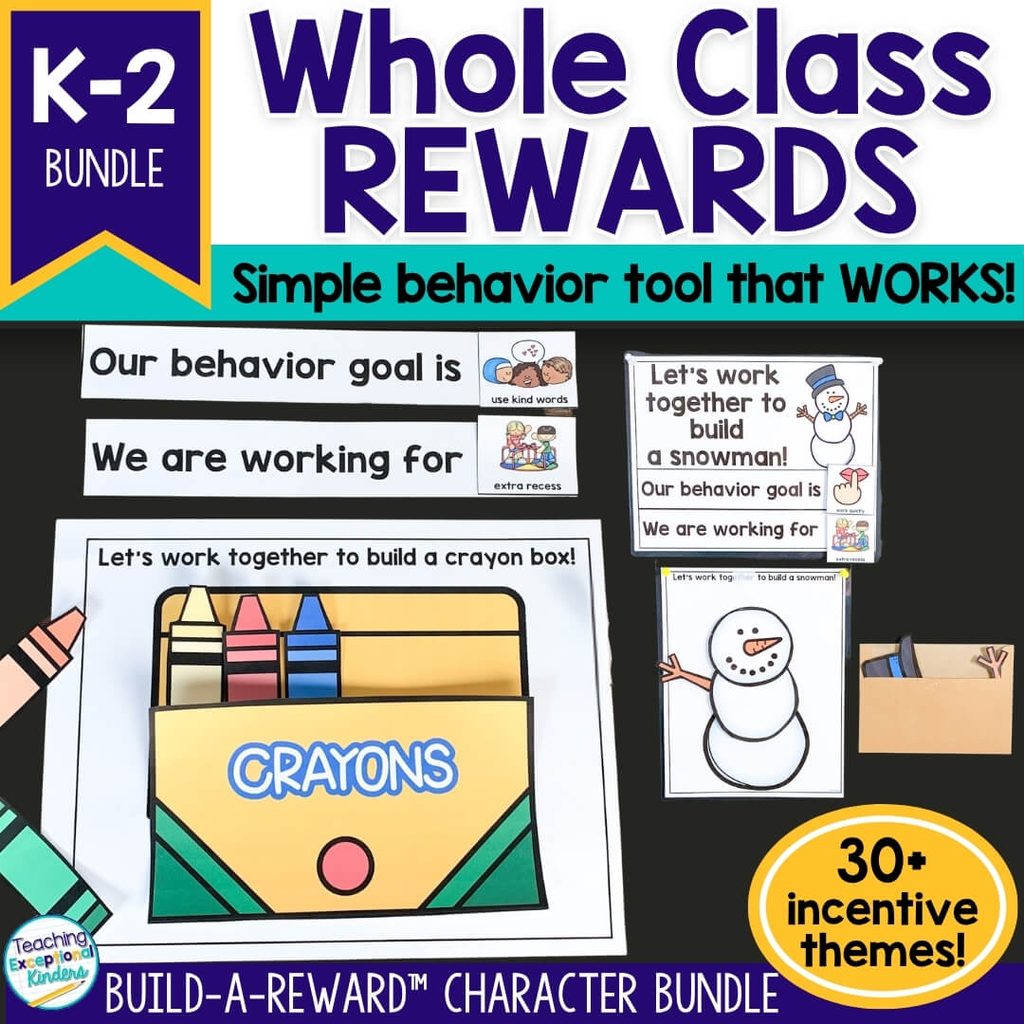
Build-a-Reward is a visual classroom reward system where students work together to build a character, one piece at a time, as they demonstrate a specific positive behavior.
You start by choosing a character your students will be excited to build. Maybe it’s a turkey in November, a jack-o’-lantern in October, or a snowman or reindeer in December. The changing characters keep things fun for your kindergarteners, but the actual system stays the same.
Next, you choose ONE behavior for your class to work on. This is the most important part! Rather than asking students to improve every classroom behavior at once, focus on one specific expectation that’s causing problems right now.
Maybe your students are calling out during lessons, struggling to follow directions the first time, or getting noisy in the hallway. Choose one behavior you want to see more often and make that your class goal.
The Build-a-Reward Characters Bundle includes behavior goal picture cards, so students have a visual reminder of what they’re working on. You’ll also choose a classroom reward, such as extra recess, a dance party, show and tell, or extra center time. Many of these rewards don’t cost a thing, and there are picture cards for those, too.
Once you’ve chosen your character, behavior goal, and reward, you’re ready to introduce the system to your students.
One of the things I love most about Build-a-Reward is that you can adjust how students earn pieces based on the behavior you’re working on and what makes sense for your classroom.
Let’s say your class is working on raising hands instead of calling out. During a read-aloud, you notice a student remembering to raise her hand and wait to be called on. You can recognize that positive choice and invite her to add a piece to the class chart.
Now you’ve reinforced the behavior you want to see, given that student some positive attention, and helped the entire class get one step closer to earning its reward.
You can also award pieces based on how the class does overall. For example, if your goal is working quietly, you might check in with your students after a lesson or at the end of the day. Talk about how things went, ask students to reflect on their progress, and decide whether they’ve earned another piece.
Not every student has to demonstrate the behavior perfectly for the class to earn a piece. You can recognize students who are doing a great job even when a few classmates are still struggling. One child having a difficult day shouldn’t keep everyone else from making progress.
And here’s one rule I always recommend: Never take away pieces students have already earned. Once they’ve earned that progress, let them keep it. You want students to trust the system and feel excited about working toward their goal.
A common mistake with classroom reward systems is making students work toward a reward for too long. If your kindergarteners have been trying to earn something for three weeks and they’re still nowhere close, it’s going to be hard to keep them motivated.
I recommend setting up your Build-a-Reward chart so students can complete it in about five school days or less, especially when you’re first introducing the system. For behaviors you’re reinforcing frequently, you might even have students earn their reward every two or three days.
The charts include different numbers of pieces, so you can choose one that works with your plan. If you want to award one piece each day, a five-piece character might be a good fit. If you’re planning to award two pieces a day, you could choose a character with around ten pieces.
The important thing is to make the goal achievable. When students see that their positive choices lead to progress and that they really do earn the reward you’ve promised, they’re more likely to trust the system and stay excited about participating.
Absolutely! And this is one of the biggest reasons I love Build-a-Reward for kindergarten classroom management.
Let’s say you start using the system in November because your students are constantly calling out. You choose the turkey character, focus on raising hands, and work together to earn a class reward.
After a little while, you notice that calling out is getting better, but now your hallway transitions are becoming a problem. You don’t need to start searching for an entirely different behavior management strategy. You can keep using Build-a-Reward and simply change the behavior goal to walking quietly in the hallway.
You can even keep using the same turkey! Or when December rolls around, switch to a snowman or reindeer to give your students something new to build.
The characters change, and the behavior goals change, but your students already understand how the system works. You’re not spending time introducing a brand-new reward system every few weeks.
And once you’ve printed and prepped the characters, you can save the pieces and use them again for years to come. That means less time creating new behavior charts and more time focusing on the positive choices your kindergarteners are making.
Start with the one behavior that’s making your school day harder than it needs to be. Maybe it’s calling out, noisy transitions, or students needing repeated reminders to follow directions.
Instead of trying to fix every behavior at once, choose one specific goal and give your students a visual way to see their progress.
That’s what makes Build-a-Reward so helpful. You’re giving your class something to work toward together while creating more opportunities to notice and celebrate the behaviors you’re already teaching.
And you don’t have to create the system from scratch! Our Build-a-Reward Characters Bundle includes 31 themed character charts, 35 behavior goal picture cards, and 35 reward choice cards. The behavior goal and reward cards are editable, so you can customize them for your classroom.
You’ll still need to print and prep your materials, but the characters and visual supports are already created for you. Once they’re ready, you can use them again and again throughout the school year.
Teaching Exceptional Kinders Links and Resources:
The Kindergarten Writing Toolbox
The Kindergarten Management Toolbox
Follow me on Instagram @teachingexceptionalkinders
More about The Kindergarten Toolbox Podcast
Welcome to The Kindergarten Toolbox Podcast, your go-to guide for creating calmer classrooms and more confident writers in the wonderfully unique world of kindergarten.
I’m Amy Murray — former kindergarten teacher, Type C “organized-in-piles” human, and vanilla-latte enthusiast. After years of helping teachers streamline their classroom routines with tips and tools that actually make sense for 5- and 6-year-olds, I created this podcast to support you with the practical strategies you’ve been craving.
Each episode is short, actionable, and designed to help you:
✔ simplify classroom management
✔ reduce behavior chaos with systems that stick
✔ teach writing in a way that meets beginning writers where they are
✔ build routines that make your day flow
✔ use visuals, tools, and expectations that really work in K
Whether you’re a brand-new kindergarten teacher or a seasoned pro looking for clarity and calm, you’ll find step-by-step support to help you feel more confident and in control.
Because kindergarten isn’t just the new first grade, it’s a world all its own, and you deserve tools that actually work.
Hit follow so you never miss an episode…
Here’s to calmer days and more confident writers!